Pages

Showing posts with label Balrogs. Show all posts

Friday, June 11, 2010

Jaws of Unquenchable Thirst -- A Tidbit of Tolkien Ecocriticism

On a recent road trip back to the Twin Cities from somewhere in the middle of Wisconsin, the lady and I listened to an episode of This American Life about why General Motors has continually lost revenue to foreign competitors (namely Toyota) for the last 30 years. The show centered around the joint-venture plant called "NUMMI," that is, New United Motor Manufacturing, Inc., a cooperative endeavor between GM and Toyota that could have shown the United States' biggest auto manufacturer how to increase both efficiency and sustainability while still maintaining profits.

In any case, you know the end of the story, at least generally speaking -- GM didn't learn nothin', and went bankrupt because of it. This episode details the repeated opportunities the NUMMI plant afforded GM, and the repeated, persistent, idiotic refusal of GM's top executives to change their company in ways that could have saved them from, well, its near-death experience last year. In every instance, they were more concerned with the immediate profits of CEOs and shareholders than long-term interests such as sustainable-energy vehicles, better working conditions for laborers, avoidance of Chapter 11 proceedings, etc. The episode is exceedingly interesting, featuring interviews with several high-level managers and executives who were involved with the NUMMI project.

On another car ride recently, this one likely from work to home or vice versa, I was listening to a story on MPR about the coal mine explosion in West Virginia that killed 29 people. Specifically, the radio host interviewed a Mine Safety Expert regarding investigations into Massey Energy Company's safety policies. Once again, the corporation was more interested in its own profit margin than the lives of its workers, even to the point of implying in several memos (but of course not exactly stating outright) that worker safety concerns are always secondary. After all, the money comes from the coal, not from the miners making it out of the tunnels in one piece at the end of the day.

And, of course, there's the catastrophic event of BP unleashing a Balrog* -- er, millions of gallons of crude oil into the Gulf of Mexico. Shockingly, they cut corners and greased up government officials (under the Bush administration, wouldn't you know) in order to swell their coffers. And 11 people died, not to mention the as-yet untold damages to multiple ecosystems upon which thousands depend for their livelihoods. And, you know, the Earth is way prettier when not slicked with the decomposed remains of prehistoric lifeforms, but hell, if they don't care about their sentient employees, who can expect them to give a fuck about a few pelicans?

I guess the solution is: Jesus H. Christ, you oblivious persons and wildlife, stop putting yourself in the path of these few dozen ass-wipes trying to make a buck. Or you know, a few billion that they don't even know what the fuck to do with (Exxon-Mobil continues to be the United States' most profitable company).

In the wide realm of Tolkien criticism (you saw this coming, didn't you?), exploitation of resources in order to consolidate power (i.e., money) is frequently likened to the recklessly destructive actions of Saruman and his minions at Isengard. Indeed, Peter Jackson's film version of The Two Towers goes so far as to have ol' Sharkey saying "the forests will burn in the fires of industry," which to me is about as clear a finger you can point at ecologically irresponsible organizations.

But as we drove home from WI that day (I was in the passenger seat, and thus probably waxing more philosophical than otherwise), looking at some pretty sun rays coming down through dark rain clouds, the concept of these corporations as individual entities (which, according to the Supreme Court, they are) struck me as something else entirely. They don't even seem to be as rational or as deliberate as Saruman was in his machinations to conquer Middle-earth and destroy the natural world in doing so; they seem to me more akin to Carcharoth (also called Anfauglir, the Jaws of Thirst), the watch-wolf at the gate of Angband who, after biting off the hand of Beren that holds a Silmaril, is driven utterly mad by the jewel's power. He rampages all across Middle-earth attempting to slake his now unquenchable thirst, inconsolable and unreachable to logic or reason of any kind, rending apart all who come in his path. The only choice left to Elves and Men is to either slay him or continue to suffer the swath of death and destruction he cuts through the green, living lands of the world.

To quote Théoden, "What can men do against such reckless hate?" The whole thing would be a lot simpler if "ride out and meet them" was the appropriate response, swords a-swinging and a-cleaving. But really, the day at Helm's Deep is saved by the arrival of Gandalf and Théoden's allies -- the key word being "allies," in that unity is required to defeat the hosts of the enemy. Holding true to the comparison, though, the Rohirrim didn't really fight back until all was nearly lost. Such seems the likely outcome in our lives, as well.

Really the answer, I think, is to just wake up the Ents. Or, in the event we can't find any, build some robotic ones, maybe. I think laser beams in their eyes would also expedite the whole process.

*Excuse the slip-up. Crude oil and Balrogs are just so similar. I mean, both are readily flammable, hide in deep underground caverns, and are, according to all evidence, impossible to stop once unleashed. Incidentally, crude oil and Balrogs tend not to cause problems if you just leave them the fuck alone. Just sayin'.

Saturday, April 24, 2010

Wings or No Wings -- That Is Not the Question

God what an atrocious title.

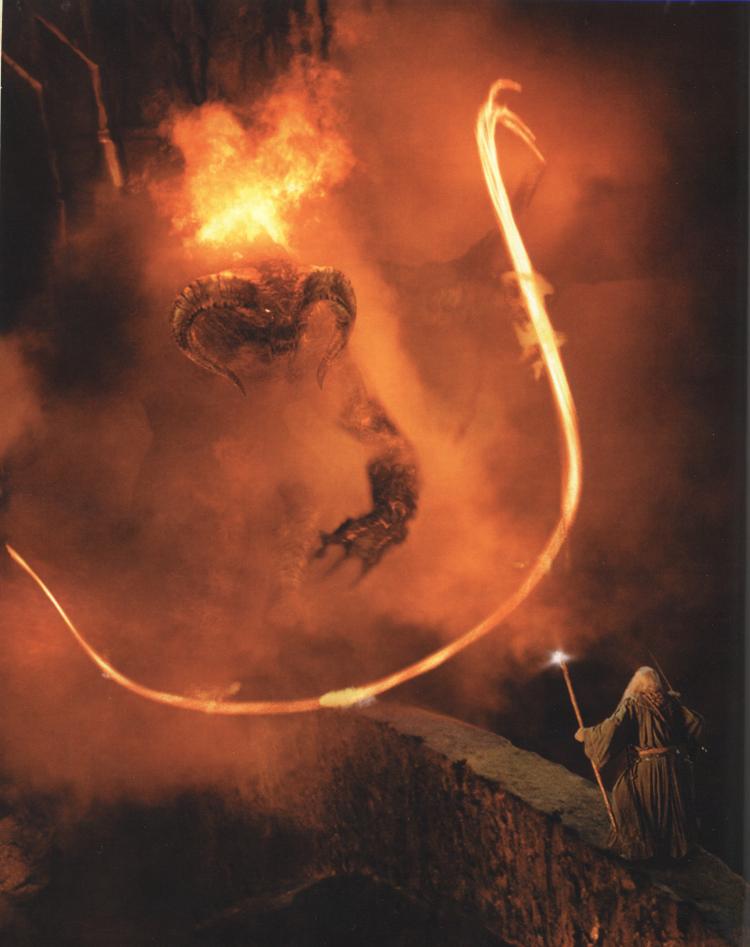
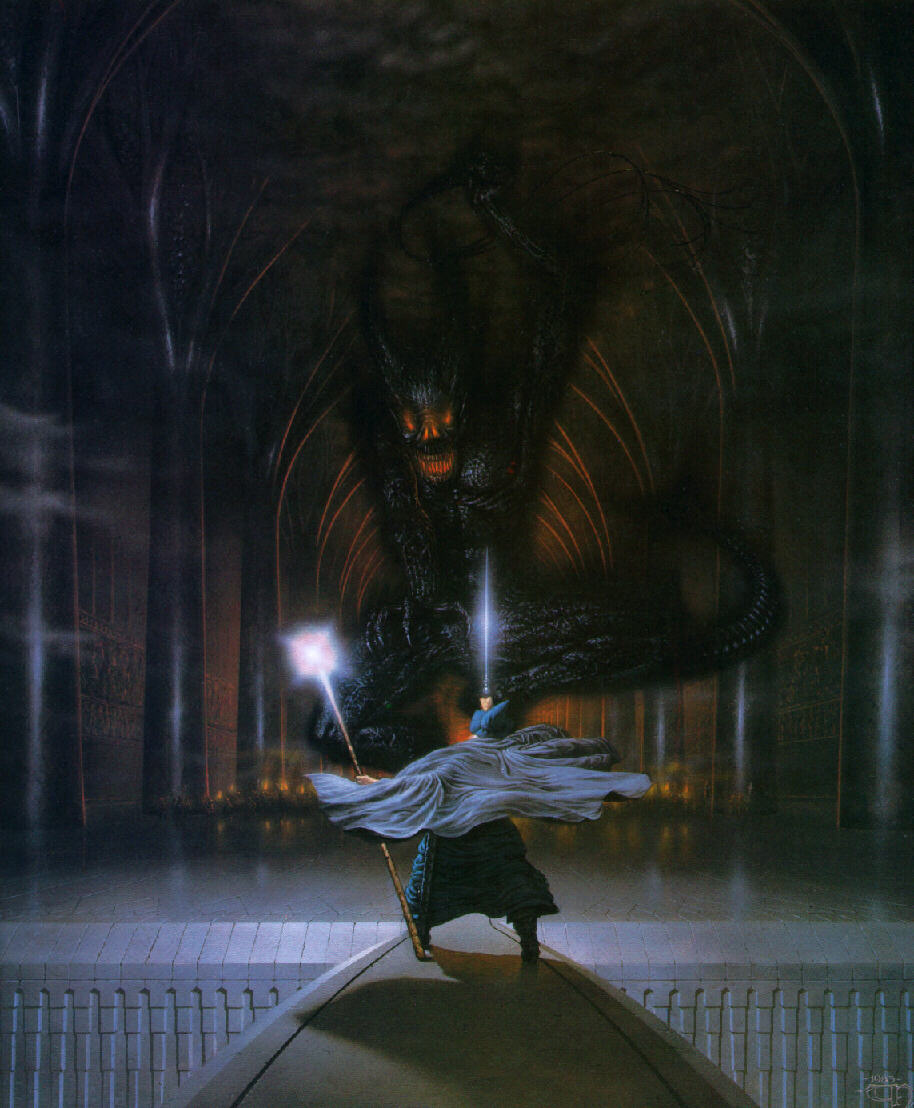
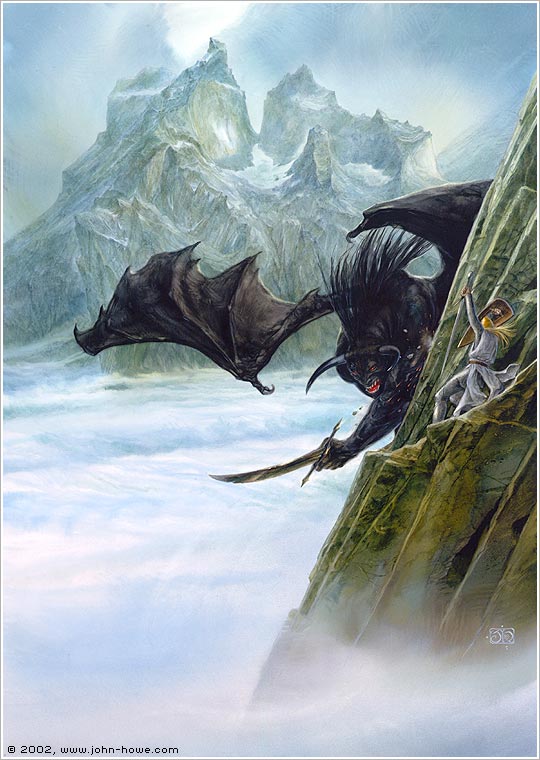
Anyway, according to The Encyclopedia of Arda, this single question receives more user input than any other of the literally hundreds of entries on their site -- to such an extent that they have devoted several pages to the discussion of whether a Balrog has wings, whether they can fly (assuming they have wings), whether they can change shape and size at will (in order to accommodate both sides of the argument), etc. The subject has inspired scholarly essays, full-length book chapters, and a general feeling of chaos and uncertainty among Tolkien enthusiasts. If we don't know whether a Balrog has wings, then gosh darn, is there anything we can really know for sure about Middle-earth?

To start -- most coherent essays on this issue that I've read conclude that, based on painstakingly nit-picky considerations of what constitutes a metaphor, Balrogs probably don't have wings in the same sense as, say, the Great Eagles (see: deus ex machina), or the Nazgûl's flying beasts. To the No-Wings camp, this seems to justify the belief that Balrogs are utterly bereft of any sort of scary adornments attached to their backs, doomed to wander the darkened halls of Moria or Who-Knows-Where wearing an immortal sadface for their inability to take to the skies. (No-Wings folks don't seem to raise any stink about visualizations of Balrogs with tails, despite the fact that Tolkien never used the word "tail" in reference to them.)

But just like the camp that says they do indeed have actual, honest-to-goodness wings, that interpretation takes a flying leap in reaching its conclusion. One thing is (almost) certain: Balrogs don't fly. At least, we should assume this is true considering they fall to their deaths often enough that, if they could fly, they'd also have to be abysmally stupid (pun absolutely intended). But it is still entirely plausible that they might have wings, if only of a shadowy, ethereal sort. Why? Because they're servants of Morgoth, and as such, there's one thing they enjoy doing above almost anything else -- looking scary.

Think about the most descriptive passages concerning what may or may not be wings on a Balrog:

'His enemy halted again, facing him, and the shadow about it reached out like two vast wings.'
and
'...suddenly it drew itself up to a great height, and its wings were spread from wall to wall...'

The Fellowship of the Ring, II 5, "The Bridge of Khazad-dûm"

If Tolkien didn't want us to imagine the shadowy cloud of a Balrog as looking strikingly similar to wings, why would he use the word twice within a few paragraphs, and in the only real physical description of this creature? Shadowy and ethereal does not mean functional, but it does mean it'll be lookin mighty intimidating -- which, as I'm sure none will deny, is exactly what Tolkien's bad guys just loooove to do.

This argument has been made before -- i.e., "A Balrog can have wings if it wants to have wings, because it's a lesser god and they do what they want." Well... cosmetic, non-functional, scary-as-hell wings, definitely.

Further, let's think about Tolkien's use of his languages, as we always should. Their names in both Sindarin and Quenya mean "demon of power." How do most people in the western hemisphere imagine a demon? Granted, there are many, many possibilities -- even a cursory glance at Wikipedia's page on demons reveals "demonology" to be a massive and convoluted subject (almost certainly more so than Tolkienology). However, my guess would be that a majority of people would describe a large, man-like creature with beastly features, horns, and wings, à la Lucifer and many other Christian visualizations of fallen angels (which, by they way, is more or less what Balrogs are). Search Google Images and see what comes up.

To my extensive (but necessarily incomplete) knowledge, Tolkien does not use the morpheme for "demon," in any of his languages, to collectively describe a class of creatures other than Balrogs. "Orc" can also mean "demon" in his Elvish tongues, but it also carries other connotations, and as far as I can tell, "rog" in "Balrog" and "rauko" in "Valarauko" are not etymologically related to it. ("The word [orc] is, as far as I am concerned, actually derived from Old English orc 'demon', but only because of its phonetic suitability" -- the author, The Letters of J. R. R. Tolkien) Regarding his use of the morphemes "rog" and "rauko," though, this might be an indication that "demon" meant something fairly specific to him, especially considering that, despite being a devout Catholic and acknowledging The Lord of the Rings as a "fundamentally religious" work, he almost always avoided using words or concepts with any strong Christian connotations. Once the reader becomes aware of the meaning of the creature's name, it seems nearly unavoidable that many should imagine it with wings, or at the very least, extremely wing-like forms expanding behind it.

Fortunately for the casual fan, but unfortunately for us Wing-Agnostics, Tolkien was actively against forcing a single, particular meaning on the reader. His primary interest was to entertain with an enjoyable fantastical narrative, and he frequently indicated his displeasure with both over-analysis of a text to the point of meaninglessness ("He who breaks a thing to find out what it is has left the path of wisdom" -- Gandalf), and with the "tyranny" of authors who intentionally fashion a story so as to deny any freedom of interpretation. See The Letters of J. R. R. Tolkien for many examples of this sentiment, as well as the Foreword to The Lord of the Rings.

My final conclusion, then, is basically an altered version of an above statement: Balrogs (almost certainly) don't fly, but a Balrog can have wings if you want it to have wings, because Tolkien was an author who wanted you to enjoy the story to its fullest. My Balrogs have wings of shadow because I think they look more intimidating and evil that way, and that enhances my enjoyment of Tolkien's writing. Tolkien was vague about the appearance of Balrogs -- probably intentionally, what with the whole "cloaked in shadow" thing. It's a fact we should face with excitement rather than frustrated deliberation.

As of two days ago, I have a much more important question on my mind. Balrogs: hosts or a handful? The answer could change my visualization of an entire age of Middle-earth.