Pages

Showing posts with label Sauron. Show all posts

Thursday, June 3, 2010

Brilliant Tolkien Passages, Vol. I

Blunt as Morgoth's mace, that title. If you're not into Tolkien, you will be both bewildered and bored to tears by the extent of this post.

Thus begins what will likely be a very long series of entries in which I'll highlight and comment on a selection from the writings of J. R. R. Tolkien that I find especially insightful, moving, funny, etc.
As some of you may know from the succinct, conveniently-placed "Currently Enjoying" list to the right side of this text, I'm reading through The History of Middle-earth. What you wouldn't know from that conveniently-placed list is that it's the first time I've done so with the express intent of getting through them cover to cover. Retain your gasps, please; it's extremely dense reading at times, particularly if you look at all the endnotes Christopher Tolkien sticks in there. But it's also very rewarding for a Tolkien enthusiast to understand the truly lifelong creative process that went into Middle-earth.

Case in point: this entry's selection, which comes from The Lay of Leithian, the poetic version of the tale of Beren and Lúthien, written in octosyllabic couplets and found in The Lays of Beleriand. In this excerpt from the poem (which, only about three quarters finished, extends over 4000 lines), we are treated to what is perhaps the very first textual appearance and description of Sauron, here called Thû. Beren and (Finrod) Felagund, disguised as Orcs, attempt to sneak past Tol Sirion, an Elvish watchtower now inhabited by Morgoth's servants and called Tol-in-Gaurhoth (Isle of Werewolves). Enjoy!

An isléd hill there stood alone
amid the valley, like a stone
rolled from the distant mountains vast
when giants in tumult hurtled past.
Around its feet the river looped
a stream divided, that had scooped
the hanging edges into caves.
There briefly shuddered Sirion's waves
and ran to other shores more clean.
An elven watchtower had it been,
and strong it was, and still was fair;
but now did grim with menace stare
one way to pale Beleriand,
the other to that mournful land
beyond the valley's northern mouth.
Thence could be glimpsed the fields of drouth,
the dusty dunes, the desert wide;
and further far could be descried
the brooding cloud that hangs and lowers
on Thangorodrim's thunderous towers.

Now in that hill was the abode
of one most evil; and the road
that from Beleriand thither came
he watched with sleepless eyes of flame.

....

Men called him Thû, and as a god
in after days beneath his rod
bewildered bowed to him, and made
his ghastly temples in the shade.
Not yet by Men enthralled adored,
now was he Morgoth's mightiest lord,
Master of Wolves, whose shivering howl
for ever echoed in the hills, and foul
enchantments and dark sigaldry
did weave and wield. In glamoury
that necromancer held his hosts
of phantoms and of wandering ghosts,
of misbegotten or spell-wronged
monsters that about him thronged,
working his bidding dark and vile:
the werewolves of the Wizard's Isle.

From Thû their coming was not hid;
and though beneath the eaves they slid
of the forest's gloomy hanging boughs,
he saw them afar, and wolves did rouse:
'Go! Fetch me those sneaking Orcs,' he said,
'that fare thus strangely, as if in dread,
and do not come, as all Orcs use
and are commanded, to bring me news
of all their deeds, to me, to Thû.'

From his tower he gazed, and in him grew
suspicion and a brooding thought,
waiting, leering, till they were brought.

[Beren, Felagund and Co. appear before Thû, he questions them, and grows still more suspicious.]

Thû laughed: 'Patience! Not very long
shall ye abide. But first a song
I will sing to you, to ears intent.'
Then his flaming eyes he on them bent,
and darkness black fell round them all.
Only they saw as through a pall
of eddying smoke those eyes profound
in which their senses choked and drowned.
He chanted a song of wizardry,
of piercing, opening, of treachery,
revealing, uncovering, betraying.

As noted in a previous post, Sauron (or at least, the figure who occupied Sauron's place in the narrative) was originally a great predatory feline called Tevildo, Prince of Cats. Tevildo was, to be quite honest, comically vain and not terribly bright, and therefore difficult to take seriously -- more like to a crabby house cat than the eventual Dark Lord of Mordor. And though in Leithian his persona has almost completely morphed into the cunning, cruel, and hateful form we recognize, in common with the feline portrayal we still find a curious emphasis on eyes and watching, making it quite apparent that Sauron's primary character element is one that survived almost thirty years of further revision and development, from the writing of The Lay of Leithian in the late 1920s to the publication of The Lord of the Rings in 1954 and 1955. The last three lines, with the repeated use of active participles, especially evoke a relentless gaze from which one cannot hide.

The feline origin of the Tevildo/Sauron character was, of course, not destined to completely die out, as we see in this passage from The Lord of the Rings:

"The Eye was rimmed with fire, but was itself glazed, yellow as a cat's, watchful and intent, and the black slit of its pupil opened on a pit, a window into nothing."

I always find those last four words particularly chilling. And, again, the sorcerous power to uncover all that is hidden:

"The Eye: that horrible growing sense of a hostile will that strove with great power to pierce all shadows of cloud, and earth, and flesh, and to see you: to pin you under its deadly gaze, naked, immovable."

I read once that Tolkien's editors/publishers were wary of a novel in which, after hundreds of pages leading up to a decisive moment with monumental implications (i.e., All Lands Covered in Darkness or... Not), there is no direct confrontation with the Enemy. But it is precisely this aspect of Sauron in The Lord of the Rings that allows him to function as such a terrible force: he cannot be faced directly, and thus he remains a mystery beyond all our power and our knowledge -- literally a shadow.

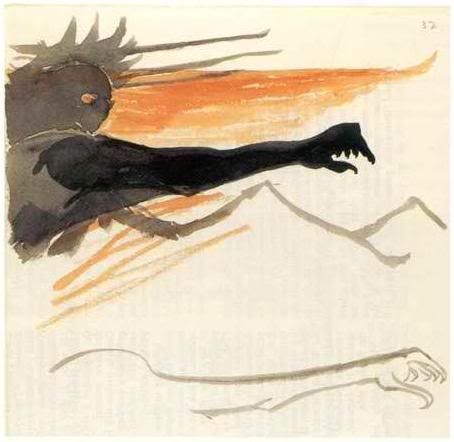
And lastly, an image of Sauron painted by Tolkien himself:

Wednesday, May 12, 2010

PUBLIC SERVICE ANNOUNCEMENT

In some of J. R. R. Tolkien's earliest writings, the forerunner of Sauron, the Dark Lord of Mordor, was a great big nasty predatory feline called Tevildo, Prince of Cats.

Remember that next time your feline "friend" sits on your lap and purrs, or watches you with eyes glowing in the dark. He's probably plotting to overrun the world with his wicked servants and enslave you.

Monday, January 4, 2010

Who would win in a fight - Sauron or Voldemort?

And now for something completely different... Drawing on the classic geek tradition of pitting two sci-fi/fantasy characters against one another to determine superiority, I give you Sure as Shiretalk's first fictional deathmatch: Sauron vs. Voldemort.

I hereby disavow any attempt at objectivity or fairness whatsoever, for obvious reasons. I trust no one will complain, though, as this really isn't a fair fight to begin with. It's just funny. Anyway -- an introduction for the combatants.


Sauron, the Dark Lord of Mordor, is the embodiment of evil in The Lord of the Rings and several other works by J. R. R. Tolkien. He is an ancient supernatural being, often likened in form to an angel or a lesser god, who possesses immeasurable physical and spiritual power and commands countless thousands of the foulest and most cruel creatures in Middle-earth through sheer force of will. His stronghold in the land of Mordor is nearly impenetrable; in single combat, only four opponents in his long history have bested him, and even then the defeat was only a brief respite from his repeated attempts to cover all the world in darkness. He is the maker of the One Ring of Power, arguably the most powerful force of corruption and domination in all sci-fi/fantasy writing. Plus, he's got that badass spiky armor and is clearly watching us from outer space.


Voldemort of J. K. Rowling's Harry Potter novels is an orphaned, emotionally unstable villain who, after receiving training at a magic school somewhere in the mysterious uncharted wilderness of England, decides he's pissed at the world (or something) and goes on a killing spree after gathering equally angsty and/or racist-against-normal-people followers to his nondescript cause. Then, when he hears about a child being born who might be able to stop him being such a wanker, he tries to off the kid before he's old enough defend himself. In a flash of brightly-colored magic and glaring plot inconsistency, he's disembodied and goes into hiding for some 10 years, after which he is repeatedly foiled by a handful of teenagers in his attempts to just get back into some kind of body.

Now, obviously we'll have to put Voldemort and Sauron up against each other in corporeal form, otherwise we're bound to get tangled up in arguments of what powers they'll have, which minions are allowed, how many, etc. etc., which would require entirely too much effort for a battle this one-sided. For the sake of generosity, let's give Voldemort the home-field advantage. As he doesn't seem to have a single stronghold or other such headquarters (what kind of hack is this guy, anyway?), we'll say that's pretty much anywhere but Mordor. Hell, let's even give him the element of surprise, for good measure.

So, here's Sauron, strolling down the lane, minding his own Dark-Lordly business, day-dreaming of all the myriad ways he could enslave the known world, when out jumps Lord Voldemort, wand at the ready. "What's this," wonders Sauron, "another poncy Elf trying to steal my jewelry? Wait, what's with his nose? It's, like, not there..."

At this point, attempting to engage Sauron in combat, Voldemort might attempt to hurl some of those flashy lights from his wand accompanied by distorted Latin phrases, perhaps even that most dreaded spell in all of the Potter-verse -- the Killing Curse (which sounds suspiciously like the most common utterance of every amateur magician on the planet; wonder if that's ever gone wrong for any of their pet rabbits...).

Well, after the smoke has cleared, we might expect to find Sauron's empty armor lying in heap at Voldemort's feet. It was, after all, the Killing Curse. Whoa.

But, much to Voldemort's chagrin, we find Sauron, standing quite as he was, halted in his tracks, swatting those obnoxious lighting effects out of his eyes. It apparently takes more than a conjurer of cheap tricks to rub out the fucking Dark Lord of Mordor, Enemy of the Free Peoples of Middle-earth. Who knew?

Now, Sauron can only assume that this puny human's action was an attack, ineffective though it was, and as such should generate a reaction of equal or surpassing prejudice. Depending on Sauron's current disposition, I foresee two possibilities: if he's up for a bit of fun and games, he might decide to enslave Voldemort with his unmatched strength of will (augmented by the Ring), forcing him to, say, jump into the Crack of Doom, or drink bleach, or otherwise dispose of himself in some unpleasant manner. Or maybe Sauron's just not in the mood for nancing about, in which case this will likely happen. After which, the Lord of the Rings will almost certainly brush his shoulders off.

Major bummer for Voldemort, eh? But he shouldn't feel too bad -- it happens to even the greatest of Elves and Men. At any rate, the lesson learned for upstart little wizards with delusions of grandeur is: Sauron will fuck your shit up.

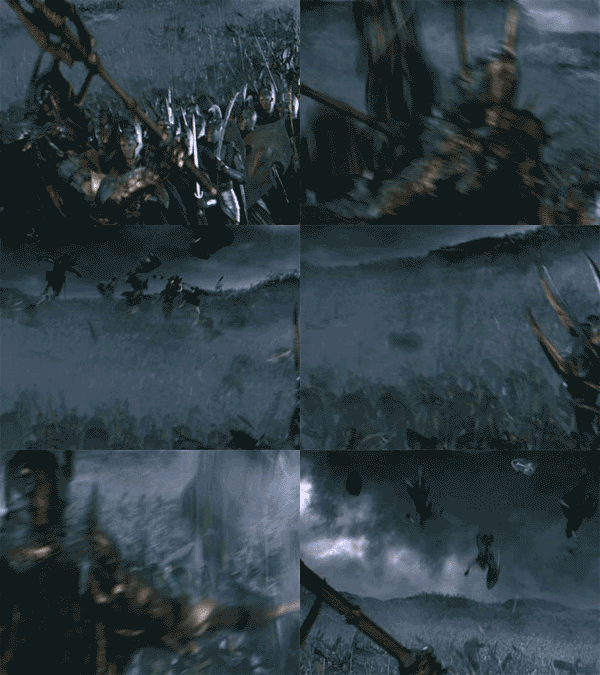
Result: Sauron wins through sheer willpower and/or giant spiky mace of doom, combined with general awesomeness. Check out a similar result on YouTube (note the Terminator 2 soundtrack over Sauron).

Next time I'll try for a more evenly-matched pair, I promise.