28 Days Later (2002)
Quality: This remix of the usual zombie flick is one of the more intense films I've ever seen. Director Danny Boyle melds the despair of an abandoned post-apocalyptic London with a very repulsive fear -- and I don't think it's fear of zombies. Because we're told early on that they're infected with a virus rather than possessed (or however zombie movies usually explain themselves), I think we're frightened more by humanity's latent violent tendencies than by the mindless hordes. The line between "normal" and Infected is progressively blurred as the film reaches its climax, and this horror/thriller ends up not really being about zombies at all.
Influence: You just don't see the stiff-jointed, shambling kind of zombies anymore, whether at the movies or in video games (parodies notwithstanding -- i.e., Shaun of the Dead). I'd say it's mostly because of this picture. It also reminds us something we're likely to forget amidst a deluge of shock-horror with less brains than any stumbling zombie (what are they on, like Saw XXVI or something?): that horror movies can, in fact, be just as intelligent as any other genre.

Quality: James Cameron is back at the sci-fi he does so well. While Avatar certainly doesn't come close to such classics as The Terminator, Terminator 2: Judgment Day, or Aliens, it has everything we love about a Cameron flick, and in true sci-fi spirit, contains a relevant social commentary -- something I feel has been rather lacking in science fiction movies lately. See my full review here.
Influence: Well, it's the second highest-grossing film of all time after Titanic (not adjusted for inflation; the top two there are Gone with the Wind and Star Wars). The way this one's selling tickets, though, James Cameron just might dethrone his own number-one in the near future. I wonder if he's officially set sail on his massive ego trip yet...?
Batman Begins (2005) and The Dark Knight (2008)

Influence: This is Batman. If you need an explanation of this character's importance in popular culture, you are either amnesic or an extra-terrestrial. One serious comment, though -- nobody who's seen these will ever take comic book films lightly again.

Quality: This was the hardest to include on the list, and I confess that it mostly got here because I can't recall any other sci-fi/fantasy films of the last ten years that really deserve to be here (at least, not ones that I've seen). However, this film is pretty good, and tends to be one of the few fantasy films other than LotR that I can handle on a regular basis. The acting is decent, and even good at times (mostly from Liam Neeson, Tilda Swinton, and James McAvoy). Well worth your time, even if its sequel was rather disappointing.
Influence: Well, this movie succeeded in reviving interest in C. S. Lewis's novels, which I suppose is worth something. The blatant Christian allegory is a little hard to swallow sometimes (at least for me), but thankfully it's not too overbearing as to ruin the whole experience. Hopefully the third film in the series, The Voyage of the Dawn Treader, will do better than the second.
Fan Reception: Having considered myself at least a one-time fan of Lewis's novels, I can say this film was a satisfying update of a story that I've really enjoyed for most of my life. If you can find it, check out the BBC's TV version from 1988, which also pretty faithfully renders this children's classic.

Quality: My hands and arms were sore after I got out of this movie. Why? I'd been gripping the armrests too hard. "Intense" is an insufficient word -- this film completely absorbed me for its full duration. Some people seem to think its blatant similarity to apartheid is overbearing, but I actually found it easier to pay attention to the details if that comparison was just a given. Fantastic acting from the lead character; my only complaint was that the primary antagonist was really two-dimensional (though nonetheless despicable). It's also pretty graphic (once it gets running, human beings are going SPLAT! almost nonstop), but it doesn't feel gratuitous, which I think is really difficult to pull off.
Influence: Hard to say. It's been making a lot of lists like this one, so it's certainly well-liked, but I fear it'll get lost in the hype around Avatar and other eagerly-awaited films of 2010.

Quality: While all of the Harry Potter movies are pretty entertaining, this one makes the list because it's the first one to really take itself seriously as a film instead of just existing to appease fans of the book. It may not be as funny or as faithful to the novel, but this is the one that comes closest to getting everything right. The addition of Gary Oldman to the cast is very welcome, and Alan Rickman is fantastic as always. Some of the scenes in this movie actually provoke an emotional response in me, which is noteworthy because most of the time when I watch fantasy movies, my only thought is: "So... why am I sitting through this instead of The Fellowship?"
Influence: Well, until dethroned by the Twilight series as the teeny-bopper flick of the year, this was the series that had everybody's hearts a-flutter (and still does to some extent, with the final novel coming out as two movies in the next couple of years). Whatevs to that. I mean... I guess I'll see them.
Fan Reception: I'm not as well equipped to answer this question, having read the novel some years ago, but I don't hear any more than the usual complaints for a book-to-film translation.
The Lord of the Rings Trilogy
 Quality: The absolutely incredible amount of time, care, and money devoted to these films is evident in almost every single frame. It will be nearly impossible for anyone to ever make another fantasy movie without being compared to the standard set here. And rightly so, as modern culture's fascination with mythological and fantastical narratives owes much (if not all) to the publication and popularity of the Tolkien's novel(s) in the 1950s and 60s. An honorable mention goes to the first installment, The Fellowship of the Ring (2001), which I regard as the best of the three on account of its nearly flawless script. These are the best fantasy films ever made, period.
Influence: This is The Lord of the Rings on the scale it deserves, expanding its already good reputation as a novel into audiences that it has likely never reached before. I routinely encounter people who love these films though they've never picked up Tolkien's books, much less any other fantasy literature. It might not yet be quite cool to be a Trekkie, but if a six-year-old can talk more intelligently than you about the One Ring of Power, you better set aside roughly nine hours (eleven, for the extended versions) and educate yourself.

Quality: The best kind of fantasy does its damnedest to blend itself seamlessly with reality, and I can't think of another film offhand that does it so directly as Pan. Refreshingly but not depressingly dark, Guillermo del Toro presents a moving tale of escapism that defies unraveling -- specifically, even after quite a few viewings, I still can't tell if Ofelia is imagining everything, or if her magical friends (and foes) are really real. Absence of evidence is not evidence of absence, as they say, which is one of many things that keeps bringing me back to this movie. Another is the acting, particularly Ofelia (Ivana Baquero), Mercedes (Maribel Verdú), and Captain Vidal (Sergi López i Ayats). Also, props to del Toro for creating a quite original, quite scary monster in the Pale Man -- rare enough these days, considering most horror bad guys these days are either run-of-the-mill axe-murderers or just too wildly bizarre in appearance to be frightening.
Influence: We've got a guy who's clearly very serious, careful, and passionate about creating fantasy narratives to direct the upcoming Hobbit films. I'll warrant this is mostly due to his success with Pan's Labyrinth.
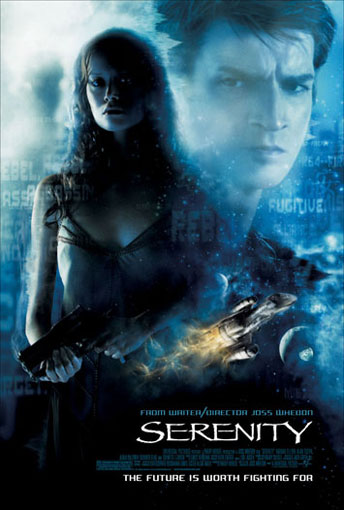
Quality: In my opinion, logical, effective character development has been sorely lacking in sci-fi films of recent years. It's almost as if, in favor of developing the plot (if it exists) or setting themselves up for a sequel (whether warranted or not), sci-fi directors have nearly uniformly decided to sacrifice their characters to uninspired dialogue and wooden performances. But while Anakin Skywalker was stomping about the galaxy pouting and putting on eye-shadow, Joss Whedon was busy abducting Han Solo and making him captain of his own TV show. Well, not really Han Solo, but Serenity features exactly the kind of characters that every Star Wars fan wanted more of -- less Hayden Christensen whingeing and more Harrison Ford blasting bounty hunters in seedy cantinas. Serenity shows up even the biggest kids on the block with its real, gritty characters and clever story.
Influence: Unfortunately, there doesn't seem to be much in this category. The film wasn't particularly successful in ticket sales, nor have the dickwads at Fox decided to give the positively fantastic TV show a second chance. At the very least, though, Joss Whedon has proven himself to be as good a film director as he is a television writer/director/producer.
Fan Reception: As with Lord of the Rings, it's rare to come across somebody who liked Firefly and didn't like Serenity. Though the show is slightly better, this is likely just due to the difference in medium.

Quality: Disregarding questions of authenticity, this is a fantastic film. With the exception of a few minor complaints (which you can read here), Star Trek's only mainstream competition for best sci-fi of 2009 was District 9. J. J. Abrams certainly can direct, and the new cast is almost always spot-on with their characters.
Influence: Suddenly it's cool to be a Trekkie. While this might be a relief from endless wedgies and loss of lunch money to any walking nerd-stereotypes out there, I'm not sure I'm happy to have all the new company around -- it's somewhat akin to hiking for hours into the middle of nowhere, coming upon a stunningly picturesque waterfall or something, and then having a bunch of loud, camera-wielding, obnoxious-American tourists stomp right up behind you. (This has happened to me, in real life, on several occasions.) It's harder to enjoy with all the extra noise. Further, the filmmakers are dangerously close to catering to mass audiences in favor of sticking with what makes Trek great, and that's baaaad.
Fan reception: I'm sure a few hardcore Trekkies out there are hard at work using red matter to construct a black hole so as to suck up the Earth and all existing copies of this blasphemous film, but I also know plenty who really like it, myself included. Time will only tell where they take the franchise.
So, there it is. I find it curious how many of them have very bluish tones in their posters. Not sure what that means.