Pages

Showing posts with label PC games. Show all posts

Wednesday, October 20, 2010

PC Games as "Art," Vol. I: The Catch-33 of Deus Ex

I'm not using that term quite right, but you'll get it in a minute. For those of you lacking the patience to plow through what's certain to be a long post, feel free to skim and comment: Name some instances in which you appreciated shades of grey in a game's plot or worldview.

Let's dive right in. I think the most important distinguishing feature of video games is the immersion of the player into the narrative. You, personally, are participating in the unraveling story, not sitting at a comfortable remove as a passive observer. The First Person Shooter (FPS) genre has an easier time achieving this than others for obvious reasons, and the home of the FPS is undoubtedly the personal computer, emerging with Wolfenstein 3D in 1992 and solidifying with Doom in 1993 (it took a full four more years before a console would produce a truly worthy counterpart with GoldenEye in 1997).

Now, nobody's trying to avoid the honest truth here -- games like Wolf and Doom were conceptual and technical successes only. Their plots can be summarized roughly by a mere handful of words: "Get weapons. Shoot [insert appropriate undesirables here]. Repeat." (The only ambiguity I see here is what exactly I'm shooting at... pixelated vampire-Hitler?) But with their undeniable popularity, these proto-shooters gave rise to a genre that has blossomed into a powerful vehicle for complex narratives. Much as Rapture's lighthouse represents but a narrow portal into the depths of its underwater city, gamers have come to expect not only an entertaining variety of gameplay dynamics in their first-person shooters, but also a wealth of story and character that they experience through that gameplay.

An FPS is possibly the easiest way to get a visceral thrill out of your gaming -- see Omaha Beach in Medal of Honor: Allied Assault or the darkened, demon-infested Mars-base of Doom 3 -- and these are fun and valuable experiences. Lord knows I love to stay up into the wee hours of the night with the lights off and the volume up and scare myself witless with some Doom 3 or Dead Space. But these are still largely reactions you can get from popping in Saving Private Ryan or any (in)decent horror flick. What I want to talk about in this entry are the responses that I think gaming has a unique opportunity to effect.

Enter Deus Ex, which I regard as the magnum opus of the modern cyberpunk-thriller genre (have you reinstalled it yet? got it running in the background while you read this?). Read my review here, or skim the Wikipedia article for more info. Dark, serious, and solidly based upon real-world politics and theoretical sciences, Deus Ex extrapolates logically upon current social climates and technological development (circa 2000) to a future overrun by parasitic, corporate capitalism (that's not too far-fetched for you, is it?) and troubled by increasingly questionable uses of bioengineering and genetic modification. The player character represents the synthesis of those two motives, a superhuman created by a "cabal of technophiles" to defend national interests against various "terrorist" groups (noteworthy is the fact that national and corporate interests are essentially equivalent in this context). Your job throughout the game is, in the simplest terms, akin to peeling an onion -- an onion whose every layer is another conspiracy of global portent.

Ok. Are you still reading? Then you probably realize that a set of problems this massive and complex simply cannot be satisfactorily solved unless you've got a big red "S" stuck to your chest. The key word is "satisfactorily." There are solutions available to you at the end of the game (three, in fact), but none of them are anything but problematic, much less offer you a sure road to human salvation and the obligatory victory cutscene. The brilliance of Deus Ex is that though you are, more or less, a superhero, you cannot save the world. All your extraordinary abilities win you is the chance to get yourself all good and invested in the outcome of the plot only to arrive at a tie between three equally dubious choices.

Many games offer the player options; a (sometimes paralyzing) degree of control over your character serves as a supporting pillar of basically every RPG in existence, and several other franchises have also capitalized on player choice as the impetus of plot development (see the Star Wars Jedi Knight series), but these choices are largely relegated to very black and white, good vs. evil situations (do I wantonly slice that hapless bystander with my lightsaber, or... not?). Deus Ex is one of a relatively small contingent of games to thoughtfully, persistently delve into moral territory so grey as to be virtually impossible to navigate. There are no right choices in Deus Ex, only choices.

Of course, we shouldn't praise moral ambiguity simply for its own sake; if we did, we might just as easily prefer characters like, say, the Joker to come out on top instead of Batman, at which point... what's the point? But the complexity of Deus Ex provokes a kind of reasoning that is really only just beginning to be utilized in gaming: ethics. To keep the superhero thread running, who's really going to boo Superman for saving a bus-load of children from toppling off a bridge? He's a stand-up guy, no doubt about it, and that kind of simplicity can be satisfying, too. My favorite novel, The Lord of the Rings, features one of the clearest notions of right and wrong ever put on paper. Clarity is definitely a good thing.

But consider, in contrast, the conclusion of a film like The Dark Knight, with Batman accused of multiple homicide. It's certainly not the ideal outcome, but the way the characters deal with it says a lot more about them than a knee-jerk reaction to the tired "rescue X from Y" trope ever could. In Deus Ex, it is the player who must react effectively to an unyielding, unforgiving environment, and I think the process of that reaction unlocks not just an exploratory gaming experience, but a self-exploratory one. Isn't that exactly what "art," however we define that almost totally useless term, is supposed to provoke? Explorations like that are vital to our media because they require us to examine and sometimes redefine the beliefs and the values with which we approach the world; they're especially vital to our video games because they continue to prove that this medium can make worthwhile contributions to modern culture.

I digress. Next time, I'll dive into Rapture in search of a little thing called "cultural relevance." Sounds thrilling, doesn't it? I know. I've had Django Reinhardt's "La Mer" on repeat for days in anticipation. (Just for clarity, that's repeat in my head. I apparently can't make it stop.) So, readers -- what other games haunt you with their moral complexity? Any I absolutely can't afford to miss? And yes, I'm already working on Fallout 3.

PC Games as Art: An Introduction

Thus commences a long-planned exploration of the medium that demands (and receives) a massive allotment of my fascination and my imaginative energies. Throughout, I hope to perpetuate, at minimum, the following idea: PC gaming is a valuable medium in modern pop culture, offering complex, entertaining narratives that are (with the rare exception) unique in that they rely entirely on decisions and actions taken by the participant rather than following a predetermined arrangement of scenes and characters. (This is not to say that game plots are not linear; rather, the manner in which they progress is determined by the player rather than the developers.)

To that end, I will not stoop to arguing why PC games are, in fact, art; at this point in time, I believe the only persons who would actively argue against this are both a) snobbish, likely aging members of academia with a vested interest in keeping a relatively new medium in its place, and b) woefully uncool (see right). Sorry, Roger, but your argument assumes that all other art forms except video games contain no dialogue whatsoever between artist and consumer, which any English major worth his or her student loans will tell you just isn't true. Instead of arguing something that's been successfully argued already, I will provide and discuss examples of PC titles and concepts which prove the point. (And for further discussion on game narratives, check this out.)

And why PC games, as opposed to video gaming in general? Two reasons. One -- quite simply, I am a PC gamer, and always will be. The personal computer offers a degree of customization and end-user freedom that is and always has been light years ahead of any other gaming platform ever produced. Case in point: user modifications, which simply do not exist elsewhere, not to mention the ability to tweak the game and/or your hardware to achieve the best performance possible for any given title.

Second, I generally regard the PC as the most economical option for today's video gamer, considering that a brand new console from each competing developer emerges every few years and costs $300+, simultaneously rendering the previous ones obsolete, while a single PC can continue to evolve with the technology.

Let me tell you now, the line about PCs being more expensive because they require constant upgrading is a steaming pile of bullshit. I purchased a pretty middle-of-the-road PC in 2006 for about $600 (AMD Athlon 64 3500+, 1GB DDR SDRAM, NVIDIA GeForce 7300 GT, for any who care) and have been happily gaming away ever since. Don't believe me? Check the BIOS date in the pic at the left. Only this past January did I have to add memory and a new video card to play BioShock and Batman: Arkham Asylum, which cost me roughly $100 (Newegg.com ftw!). I have only recently broken down and decided to replace the motherboard and processor, but that's it -- they'll be going straight into the same old casing and hooking up to the same old power supply and hard drive. The cost of maintaining a decent gaming computer is, at the very most, more or less equivalent to purchasing a single brand of consoles (e.g., Microsoft/Sony/Nintendo) over two of their generations (Xbox + Xbox 360, PS2 + PS3) -- except mine runs games and does everything else a PC can do, which means I don't have to drop an additional few hundred dollars just to be able to write this blog post or use a word processor.

And, on a pleasantly responsible note, the less you replace your electronics, the less you contribute to the problem of conflict minerals, and the less you have to take your old ones to a special recycling center or, worse, commit the wasteful and environmentally harmful act of just tossing them in the garbage.

And, on another responsible note, upgrading your own PC means you will necessarily learn a lot more about how your entertainment devices function, which is never a bad thing.

This is not to say that console games don't have their own positive aspects (in-house multiplayer rather than over the internet and their generally much larger libraries come to mind) -- I just don't plan on discussing them here, except in relation to their PC counterparts.

Well, the day is getting on, and I'm due at work in about an hour, so the "actual" first entry in this series will have to wait. As a teaser, though: I'll discuss the value of moral ambiguity and Really Tough Choices in a medium where all is dependent on player action, via Deus Ex and BioShock. Read up on them so you know what I'm on about.

Friday, February 12, 2010

Classic PC Game Reviews, Vol. II -- Deus Ex

The abundance of conspiracy theories in our culture is often attributed to some kind of latent desire in human beings for a more interesting, more colorful world. Our existence isn't already complex enough for some, it seems, so we're treated to a host of disturbing tales and urban myths about flying saucers, government cover-ups and surveillance, or hostile takeovers of our infrastructure, etc. While they're almost always far-fetched for one reason or another, I'll give them one thing -- they're certainly creative, and frequently fascinating. But what if they were all true? Such is the premise of Deus Ex, a 2000 Eidos release developed by Ion Storm.

The year is 2052, and as usual in the fictional mid-21st century, shit ain't too good. Governments are more or less entirely corrupt, and a virus with a 100% fatality rate (minus a few special individuals) decimates the less fortunate strata of society. There's a widespread suspicion that the government has a vaccine, but is failing to distribute it. The Internet is centralized at Area 51, meaning that every bit of electronically-transmitted information passes through a single location on Earth. You simply can't swing a stick in Deus Ex without hitting somebody who's got their own convoluted agenda for a new world order. Scary stuff indeed, but nothing new to sci-fi nerds so far. Read on.

In the midst of all this global hullabaloo comes the advent of human nano-augmentation. Exhibit A? The player character, JC Denton (technically, though, you're Exhibit B, following your brother Paul). You are a state-of-the-art computer/biochemistry project, your physiology augmented by nanites that alter the molecular functionality of your body, from the efficiency of your eyeballs to how high you can jump and how fast you can run. In other words, you're a BAMF who answers only to UNATCO (United Nations Anti-Terrorist Coalition), the organization that ostensibly funded your creation. You are also immune to the mysterious virus, for reasons I'll not divulge here.

Discussing even minuscule plot points would almost certainly spoil the entire game for you, but be sure that pretty much every commonly-uttered conspiracy theory in popular culture is somehow woven into the story of Deus Ex. Area 51, the Illuminati, pandemic government surveillance, and even the sci-fi staple Greys all make an appearance -- and that's not even half of what's going down in this eternal night full of backstabbing, money-grubbing, and shameless power-grabbing of planet-wide proportions (what, couldn't you tell from the screenshot?). Suffice it to say that Deus Ex features a level of complexity and detail in its story that I have not seen in any other game.

But what about the actual gameplay? Deus Ex is essentially a first-person shooter, but significant RPG elements abide as the most memorable aspects of the experience. Though the story is linear in that it will always lead you to the same locations in the same order, it is completely open-ended when it comes to how exactly you want to go about solving the problems you face. I vaguely recall from an interview with one of the developers (possibly Warren Spector?) that one of the specific goals during development was to provide the player with at least a handful of ways to approach every event in the game. Add to this the dynamic of upgrading various skill categories and installing augmentations that give you specific abilities (such as health regeneration or complete invisibility; see pic), and you have a game that is virtually endless in the different ways you can play.

Beyond all these great qualities, though, there's something that video games in general really lack -- moral and philosophical complexity. Deus Ex is at no turn in the road afraid to ask, and force you to answer, extremely difficult questions about topics such as distribution of power in political structures, the effects of extremely advanced technology on human society, and my personal favorite: a moral dilemma involving the game's title, which comes from the Latin phrase deus ex machina, literally translated as "god from the machine." Even better, the game features three unique conclusions based on who you decide to ally yourself with in the end -- and rest assured, this is possibly the hardest decision you'll ever face in the virtual world. Each choice is extremely ethically problematic, and yet each seems to hold a glimmer of hope for the ultimate fate of humanity. And once you've decided, you'll play the game all over again so you can make a different choice. It is unavoidable. It is your destiny. (Nerd-cred to whomever places that quote.)

Those who have even just started into this labyrinthine game will understand when I say there isn't any way to summarize it effectively. Concerning overall atmostphere, think of it perhaps as a skillful, engrossing, and incredibly detailed amalgam of Blade Runner, The Matrix, The Terminator, and The X-Files, with no shortage of ideas and innovations of its own. Other great aspects worth mentioning are the killer techno-punk soundtrack and the staggering amount of research the developers must have done to present their story so realistically -- you can learn almost as much about the sciences in question from the game than you can from their respective Wikipedia articles. If you enjoy story-driven gaming that hurls itself into theoretical science and philosophical dilemmas, you cannot afford to miss the greatest conspiracy-shooter of all time.

5 stars of 5.

Friday, January 29, 2010

Classic PC Game Reviews, Vol. I -- Thief: The Dark Project


Appearing in 1998 was a tough business for any PC game if it wasn't titled Half-Life, particularly for other first-person shooter types. Better just leave off the groundbreaking new genres until next year, lads.

But the folks at Looking Glass Studios didn't, and aren't we all glad. Thief: The Dark Project is the ancestor of all stealth-based games, period. It also happens to still be the most fun. No game before (or since) has so single-handedly created an entire sub-genre of first-person shooters (Thief is often called a "first-person looter" for obvious reasons).

The concept is straightforward (steal things and don't get caught), but the execution is quite complex. Your character Garrett has plenty of tools at his disposal to deal with guards, locked doors, and inconveniently-placed light sources, but supplies are limited and many situations require you to rely on patience and three-dimensional thinking (the importance of "up" cannot be overstated) to get the loot you're looking for. Imagine that -- patience as a mandatory element in a first-person shooter. I cannot stress enough how refreshing that is in a gaming world that mostly has the FPS genre constantly shouting "OMFG TIME-TRAVELING KILLER ALIEN ROBOTS FROM OUTER SPACE GRAB YOUR BFG9000!!1!"

Further, in an era of gaming where detailed graphics and physics seem to take precedence over immersive storylines, Thief puts others to shame with its beautifully-crafted cutscenes and brilliantly-detailed fantasy world full of intrigue, revenge and the undead.

Speaking of which -- Thief is also one of the most absolutely terrifying games I've ever played, surpassed in its cardiac-arresting potential only by Doom 3. To illustrate, I'll relate an anecdote from the early days of my career in larceny and graverobbing: I was wandering through the bowels of an abandoned mine, trying to find my way up to the Hammerite prison above, when what should appear in the darkened hallway ahead but a corpse, rotting happily away in a forgotten mining tunnel.

"Gross," thought I, as I stepped over it and headed on down the passage.

Suddenly a decidedly inhuman groan blasted out from my speakers (Thief is best played at high volumes to increase your sensitivity to loud or unnecessary noises). As unnerving as that was, I still had the presence of mind to spin my mouse in circles, frantically searching for the source of the sound. Nothing to be seen, so I just crouched down in the shadows and waited, which is generally the proper course of action until you know what you're up against. Unfortunately for me, I was facing away from the corpse on the ground nearby, which as you've probably deduced by now, wasn't really a corpse in the strictest sense.

Well, a few seconds later, I heard another unpleasant moaning sound, this time from away left. As I twisted to face the noise, a sickening *crack* took my health bar down to about two hit points, and I was staring in horror at a zombie looking to OM-NOM my brains. And he did. Oh, how he did.

My reaction? Near heart failure. This was the case for me on all four of the levels featuring undead foes, particularly "Return to the Cathedral," which induced complete paralysis. I was literally incapable of moving Garrett through the level for several minutes for fear of disturbing the Cathedral's ghastly residents. All of Thief's various elements -- story, music, ambient noise, lighting -- combine perfectly to completely immerse the player.

Other comments: Have you ever wanted to be Indiana Jones in a video game? Thief lets you do that in several levels, and far more satisfyingly than any of the actual Indy titles. Thief also accommodates many styles of play through three genuinely different difficulty settings and sheer open-ended level construction. It has also given way to an enormous fan-mission and fanfic following, which you can take part in at Thief: The Circle. Thief: The Dark Project certainly isn't the most influential title of its time, but it was without doubt one of the most innovative. A must-play for anyone who prefers mind-over-matter gaming.

So -- why is it underrated? Well, as mentioned before, coming out in close proximity to one of the best-selling and most critically-acclaimed games of all time is rough, especially when your game is drastically different from that particular title. But in my explorations into the demise of Looking Glass Studios in 2000, I've heard that Thief's unjustly low popularity-to-quality ratio was also due to a simple lack of effective marketing. The game does enjoy favorable opinions from pretty much everyone I talk to about it, but a strangely small number of those people have ever actually played it or its sequel, Thief II: The Metal Age.

So get out there a find yourself a copy. There's a surprising number of supposedly brand-new copies on eBay at the moment, and the entire game consists of about 3 or 400 megabytes (insta-Torrent, anyone?), so you really have no excuse. With any luck, you'll end up like me: aggressively shushing nearby friends who, with their noisy careless lifestyles, are sure to expose you to the heavily-armed guards around the corner.

5 stars of 5.

Monday, January 25, 2010

The Wonderful World of Third-Party Modding

I've been playing video games as long as I can remember. When I was seven or eight years old, I saved up my allowance for months so I could bum a ride from mom up to Funcoland and buy me a used Sega Genesis. Around the same time, one of my uncles gave my brother and I his old NES with a copy of Super Mario Bros. 3, which is easily one of the top five most good-old-fashioned-fun games in existence. That and Sonic the Hedgehog 2 made up an admittedly enormous part of my childhood.

So I guess you could say I was originally a console gamer. They have (correction: had) simple user interfaces and a gentle learning curve in most games, meaning that an interested and determined youngster like myself would have no trouble kicking Dr. Robotnik's ass out of Sonic's neighborhood. But then when I was about 11 or 12, a friend from school introduced me to the keystone of my future gaming career: Star Wars Dark Forces II: Jedi Knight. Being at the peak of my interest in Star Wars, this game had everything to satisfy my geek cravings -- spaceships, laser guns, and countless thousands of hapless stormtroopers just asking to be blasted to bits. But most importantly, it was the first first-person shooter to allow the player to become a Jedi Knight, and to wield a lightsaber. A lightsaber. Quake II, eat your heart out.


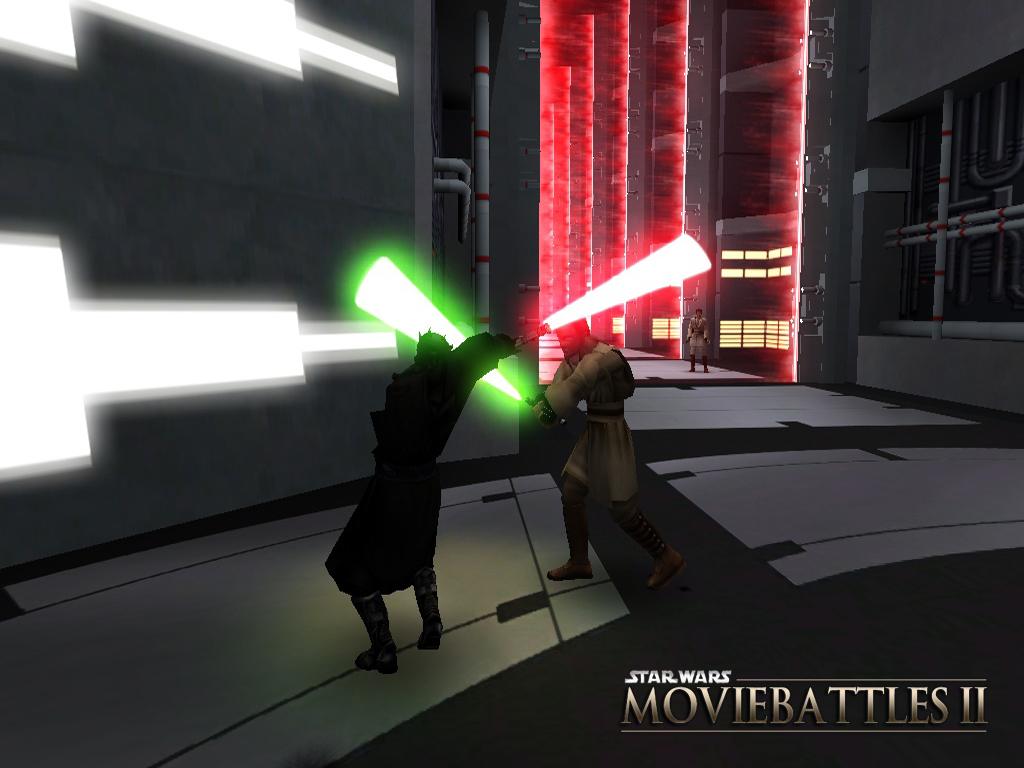
Needless to say, I bought myself a copy and didn't stop playing it (until the sequel came out). Since then I've expanded my library of PC games considerably, including most of the genres available -- first-person shooter, real-time strategy, RPG, etc. At some point along the line, though, I came across some intriguing downloads for Jedi Knight: player-created modifications that altered or added to the gameplay in some fashion. Some were more or less cosmetic, such as the ability to change your lightsaber color, or the outfit your character would wear. But others actually played around with the game mechanics, adding everything from new force powers to entirely new levels, some of which reproduced particular events from the Star Wars films. Memorable examples include Luke vs. Vader at Bespin, and the escape from the first Death Star. What's more, many of these mods were functional in multiplayer games, which added even more to the experience. The screenshot here is the finale of Star Wars Episode I: The Phantom Menace, a user-created multiplayer level for Jedi Knight: Jedi Academy.

Of course, I began to search for mods for my other favorite games too, most notably Thief: The Dark Project and Jedi Knight II: Jedi Outcast. I was rewarded with more than enough great mods to give the games a whole new dimension of interest, dramatically increasing their replay value. Indeed, some of the mods make their respective games significantly better by adding features that felt missing from the original. Many mods for JKII add Force powers that were seen in the films, but were for one reason or another not included in the stock version of the game; mods for Star Trek: Bridge Commander add new ships and new star systems from the vast canon Star Trek has to offer.


Some modders take these additions to the next level, combining many smaller mods into one big package. This often has the effect of drastically improving upon a game that has become outdated in its features and graphics or did not meet player expectations to begin with. Such is the case with the Koba yashi Maru mod for Bridge Commander, a "total conversion" that adds dozens of features to what was already an enjoyable game, though seriously undercooked. Now I can board and capture enemy wessels, or command the USS Enterprise-A and a fleet of Federation ships against a Borg Cube, or conduct systematic phaser sweeps of nearby space in the hopes of finding the Bird of Prey that can fire while cloaked (an experience every Trekkie should have at some point). Another fine example is Oscuro's Oblivion Overhaul, which as the name suggests, completely alters the gameplay of The Elder Scrolls IV: Oblivion. This one is perhaps the most impressive modding effort I've ever come across -- it adds literally thousands of new weapons, characters, factions, etc. to already massive game. And more importantly, it corrects some serious inconsistencies in the leveling system that have turned many players away from an otherwise beautifully constructed game (read an interview with the author, "Oscuro," on said issues here). It also makes the game a lot harder, which is good for those of you who were confused at the fact that a level 2 player could stomp the crap out of end-game enemies just because stock Oblivion levels its baddies concurrently with you. It's worthwhile to point out that, though Oblivion is more or less the same on all systems it appears on, only the PC version can be altered to the user's wishes.


Further still, some gamers have taken it upon themselves to expand on the virtual world of a given game by adding some brilliant story-based content. Thief: The Dark Project and Thief II: The Metal Age are two of my favorite games ever, and luckily there have been plenty of devoted taffers out there who learned to code in the Dark Engine and have produced the largest third-party library of single-player content I've ever seen, and is still being added to today (the original Thief came out in 1998). These fan-made missions have kept us all from enacting our larcenous virtual lifestyles in reality, because unfortunately the games' parent company, Looking Glass Studios, went bankrupt shortly after releasing the second title. Another sequel, Thief: Deadly Shadows, was produced a few years later, but it was far inferior to its predecessors, despite having more advanced technology at its disposal. Though a fourth is reportedly in the works at Eidos Montreal, we're all aching to relieve some more noblemen of their priceless valuables in a more updated graphics engine.


Well, until "Thi4f" arrives, we can be satisfied with The Dark Mod, which uses the Doom 3 engine to create an almost-perfect clone of Thief II, but with superior physics and graphics (pic at right). The level-editing program can also be downloaded, meaning that anyone with the persistence to learn how to use it can make their own missions and post them to the Dark Mod website (this is also true of the level editors for Thief and Thief II). Another similar such effort is Thievery UT, a multiplayer Thief game built on top of Unreal Tournament that pits players against each other as either thieves or guards. Their respective goals are simple: thieves steal stuff, guards try to stop them. It incorporates all the classic elements of the Thief series into the gameplay: a lightgem to let players know how visible they are, noise-based detection, and an array of different sorts of arrows to aid you in your burgling (water arrows to put out torches, rope arrows for hard-to-reach places, etc.). To my knowledge, there is no commercially-available PC game that includes stealth-based multiplayer.

Even more impressive, though, are games that are built entirely from scratch. Some fantastic examples include Mount&Blade, a third-person medieval combat simulator (see picture), and Star Trek: Excalibur, a forthcoming title that was originally intended as a mod for Bridge Commander, but was upgraded to eventually become a completely fan-made Star Trek game. (The visuals provided for this one so far are positively stunning.) These mods and user-created games are usually free, and if not, they're very affordable (a permanently valid serial key for Mount&Blade, which gives you access to the current game and all subsequent updates, will cost you only about $30, a little over half the price of a new retail PC game these days). This means that the developers are basically working pro bono to release some really phenomenal work.

All this geeking out really does have a purpose, besides letting you know about the incredible mods I've found over the years. I want to point out that while the video game industry has become intensely commercialized over the past five to ten years, which has in many cases led to decreased quality of the products (see: pretty much any movie tie-in game ever made), there are still communities of gamers out there who do this because they love gaming and they want to contribute to the overall experience of a certain game. In fact, it has often been the case that a modder will add incredible features to a game that, by all rights, the professional developers should've added in the first place (case in point: Bridge Commander vs. Kobayashi Maru). Many of the fan-made missions for the Thief games are arguably better than some of the originals. I think it's important that all gamers appreciate and utilize the truly massive community of computer game modding, not only because it can renew an aging game's lease on life, but also because PC games are the only kind where user modification is even possible at this point in time. Let's be perfectly clear: the level of customization in any PC game is limited only by the game engine in question and the user's determination in learning to modify the code. So until the Xbox 360 or PS3 lets me fly a Borg Cube against the Death Star, I won't even consider buying a console.